
Most listing advice arrives as adjectives: make the title compelling, lead with benefits, add social proof. None of that tells you what to change on SKU 47 at 11 pm. What actually helps is a number and a reason: this listing scores 61, and here are the four things that killed it.
So I built the smallest version of that desk. One folder, one config file, fourteen checks written in plain Python, no model calls and no marketplace API. The whole thing costs nothing to run, which is the point: you should not spend a paid request to learn that your title says "best seller".
What you need before you start
- Python 3.10 or newer. Nothing else is installed.
- One folder named listing-doctor, and two files inside it: config.json and check.py.
- Two sample listings as JSON, one deliberately bad and one fixed. You need both, because a checker that scores everything fine is broken.
- Your real listings exported as JSON: title, five bullets, description, search terms, image count, whether there is A+ or video.
Four items, about forty minutes of typing. If you skip the bad sample, you will never know whether the desk works.
Who kills what
This desk has three parties and they must not do each other's job. The code kills: length limits, missing brand, banned claims, missing specs, too few images. All of those are comparisons, not judgements, and a comparison should never be sent to a model. Your AI writes: it proposes a new title or a rewritten bullet after the code has cleared the SKU. You sign: nothing goes live without your reading it, because you are the one who eats the return rate.
The rule I keep on the wall: a checker that asks a model "does this title look good" has no opinion worth trusting. A checker that counts characters has one.
The funnel, in order
Seven stages, cheapest first. The first three are free and offline: they run before anything costs money or time.
- Export: every SKU becomes one JSON file. No scraping, no API.
- Limits: title characters, bullet count, search-term bytes. Offline, instant.
- Kills: brand name, banned claims, quantified specs, image count. Still offline.
- Coverage: are the target keywords actually in the title and bullets.
- Warnings: benefit-first bullets, repeated openings, A+ or video present.
- Human: you read the FAIL and kill list, then decide what to rewrite.
- After: the routines below re-run the same checks so a fixed listing stays fixed.
Stage 4 is where most sellers get surprised. The keyword they bid on for three months is often missing from the front eighty characters, which is the part a phone shows before the title gets cut.
Put every number in one file
config.json holds the product facts, the limits and the banned list. When you tune anything, you change one file. The weights at the bottom are how the score is computed: a FAIL on a ten-point rule costs twice as much as a FAIL on a five-point rule, and a WARN costs half.
config.json
Copy it, change the product block, keep the limits
{
  "product": {
    "brand": "Kova",
    "category": "insulated travel mug",
    "target_keywords": ["insulated travel mug", "12 oz", "leak proof", "stainless steel"]
  },
  "limits": {
    "max_title_chars": 200,
    "title_front_chars": 80,
    "max_bullet_chars": 500,
    "bullets_min": 5,
    "bullets_max": 5,
    "max_search_terms_bytes": 250,
    "min_images": 7,
    "min_quantified_specs": 3
  },
  "banned_words": ["free shipping", "best seller", "sale", "guarantee",
                   "cure", "fda approved", "100%", "#1", "eco-friendly", "non-toxic"],
  "score_weights": {"title_banned": 10, "keyword_coverage": 10, "title_chars": 8, "...": "one weight per check"}
}The fourteen checks
Nine of the fourteen are hard kills. Five are warnings, and one of those, the numeric-claim scan, always hands the decision to a human because a claim like "hot for 6 hours" needs a test log behind it, not a rewrite.
| # | Check key | What it measures | Result |
|---|---|---|---|
| 1 | title_chars | title length <= 200 characters | hard kill |
| 2 | title_brand | brand name present in title | hard kill |
| 3 | title_banned | promo and absolute claims (free shipping, #1, 100%) | hard kill |
| 4 | title_front_keyword | first 80 characters carry a target keyword | warning |
| 5 | bullets_count | exactly five bullets | hard kill |
| 6 | bullet_chars | each bullet <= 500 characters | hard kill |
| 7 | bullet_benefit_lead | each bullet opens with an outcome, not with This/The/brand | warning |
| 8 | bullet_repeat_open | no repeated bullet openings | warning |
| 9 | desc_quantified | description holds 3 or more measured specs with units | hard kill |
| 10 | search_terms_bytes | backend search terms <= 250 bytes | hard kill |
| 11 | keyword_coverage | title plus bullets cover 3 or more target keywords | warning |
| 12 | image_count | seven or more images | hard kill |
| 13 | a_plus_or_video | A+ content or video present | warning |
| 14 | compliance_scan | numeric claims need a test report | warning, hand to a human |
Two of these earn their place by catching things a writer never notices. Bullet 7 catches the habit of starting every point with the product name, so five bullets read as five restatements of the title. Bullet 8 catches the same opening words twice, which is the hand-writing version of a template.
The four checks that do most of the work
Copy these into check.py, keep the rest symmetric
def check(listing):
    title = listing["title"]; bullets = listing["bullets"]
    st = listing["search_terms"]; desc = listing["description"]

    # 1-3: the free kills. No model, no API, no cost.
    n = len(title)
    add("title_chars", "PASS" if n <= rules["max_title_chars"] else "FAIL", f"{n}/200 chars")
    add("title_brand", "PASS" if brand in title.lower() else "FAIL", "brand missing")
    hits = [w for w in banned if w in " ".join([title, desc, st]).lower()]
    add("title_banned", "FAIL" if hits else "PASS", f"banned: {hits}")

    # 9: quantification. A number with a unit is a spec; a number alone is noise.
    specs = re.findall(r"\d+(?:\.\d+)?\s?(?:oz|ml|g|hours|h|cm|in|%)", desc.lower())
    add("desc_quantified", "PASS" if len(specs) >= 3 else "FAIL", f"{len(specs)} specs")

return resRun it twice: once on junk, once on the fix
The bad sample is a real pattern, not a straw man: a 185-character title stuffed with "Best Seller", "Free Shipping" and "Guarantee", five bullets that open with "This Kova mug" or "Our travel mug", a description with adjectives and zero measurements, four images, and no A+ or video. It scored 61.
The fixed version keeps the same product and the same claims, but every claim carries a number: 6 hours of heat retention, a 30 minute upside-down shake test, a 2.9 inch base that clears cup holders, 380 g of weight. It scored 100.
| Item | Bad sample | Fixed sample |
|---|---|---|
| Score | 61/100 | 100/100 |
| Brand name | missing | found |
| Promo words | free shipping / best seller / guarantee | none |
| Measured specs in description | 0 | 6 |
| Images | 4 | 8 |
| Bullet openings | 4 start with the product | 0 |
| A+ / video | neither | both |
| Kill list | 4 items | none |
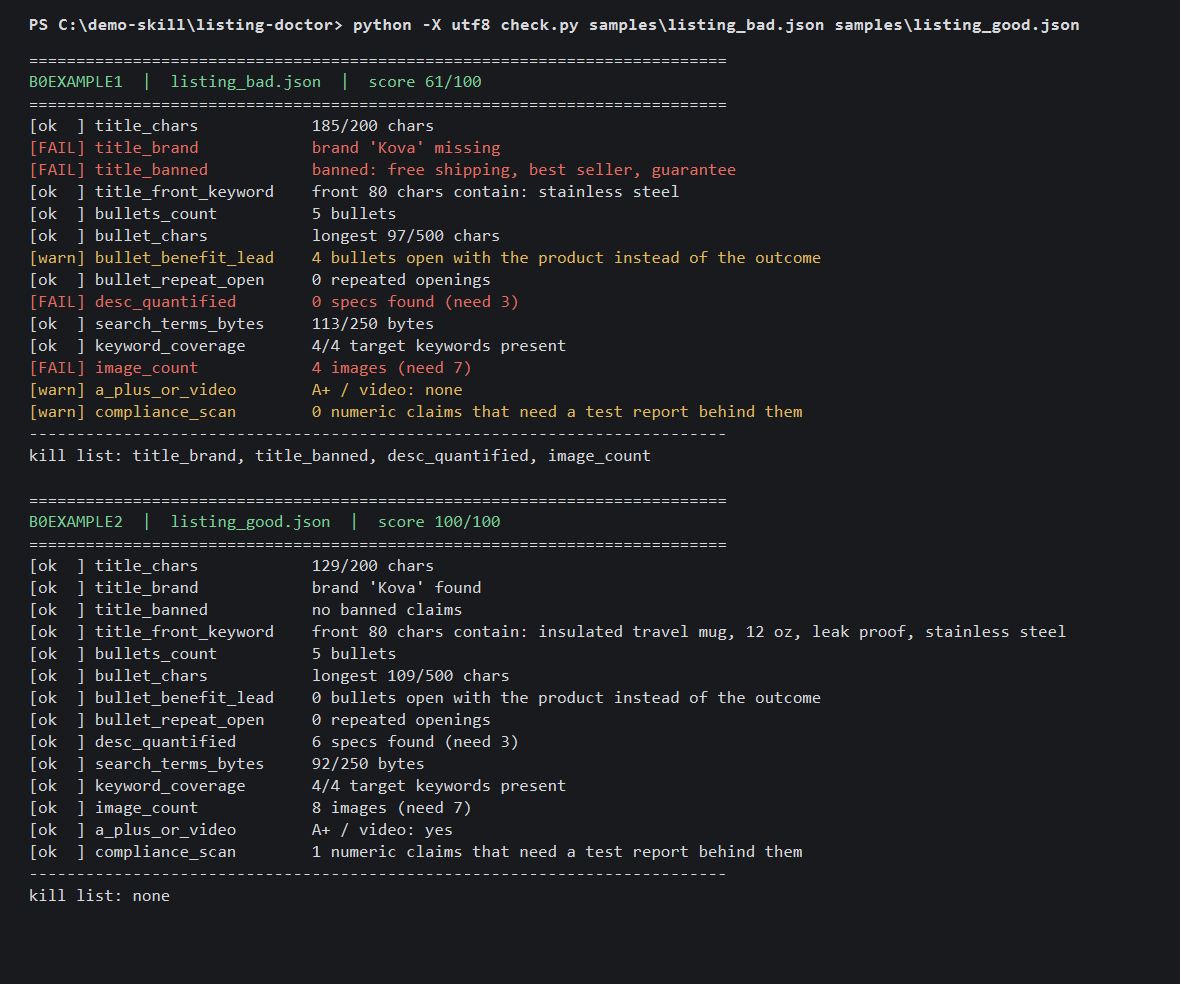
Read the kill list on the bad sample: title_brand, title_banned, desc_quantified, image_count. Three of those four are things you can fix in fifteen minutes, and each one is a reason a shopper bounces.
Three routines, one line each
The desk only pays off if it runs without you remembering. Say each of these once to your agent; it repeats them on its own schedule.
Routines to paste once
One sentence per routine, no workflow builder needed
# three routines, one sentence each, said once
Every day at 09:00, in /listing-doctor, run python check.py listings/*.json and post only the FAILing SKUs and their kill lists.
Every Monday at 10:00, collect every WARN SKU into one table sorted by score, lowest first. No explanation, just the table.
Every night at 21:30, run python report.py and post today's new FAILs, anything reverted to an old version, and the five worst SKUs.Two rules that always stop the run
- Before editing any file named config.json, ask first. Otherwise a limit quietly moves from 7 images to 4 and every score improves overnight.
- Before writing anything to the live listing, ask first. The desk drafts; you publish.
These two lines matter more than all fourteen checks. A checker that can lower its own thresholds is not a checker.
Five things that will go wrong
- Scoring your own listing without a bad sample. You get 100 and conclude the desk works, when it actually cannot see anything.
- Counting characters with len() and comparing against a limit that is measured in bytes. Search terms are bytes; accented characters cost two.
- Treating a WARN as a PASS. Warnings are where the money leaks slowly: benefit-first bullets and missing video both lower conversion without failing anything.
- Letting the AI write before the code kills. You will spend tokens polishing a listing that had four images.
- Believing the compliance scan. It only flags that a number needs evidence; whether the number is true is your job and your test report.
Everything here is offline and free, so the cost of entry is forty minutes and the cost of continuing is zero. If you want the files, the folder layout is exactly what you see above: config.json, check.py, samples/listing_bad.json, samples/listing_good.json. Run the two samples first. When the desk scores 61 and 100 on the same run, you know it is alive.