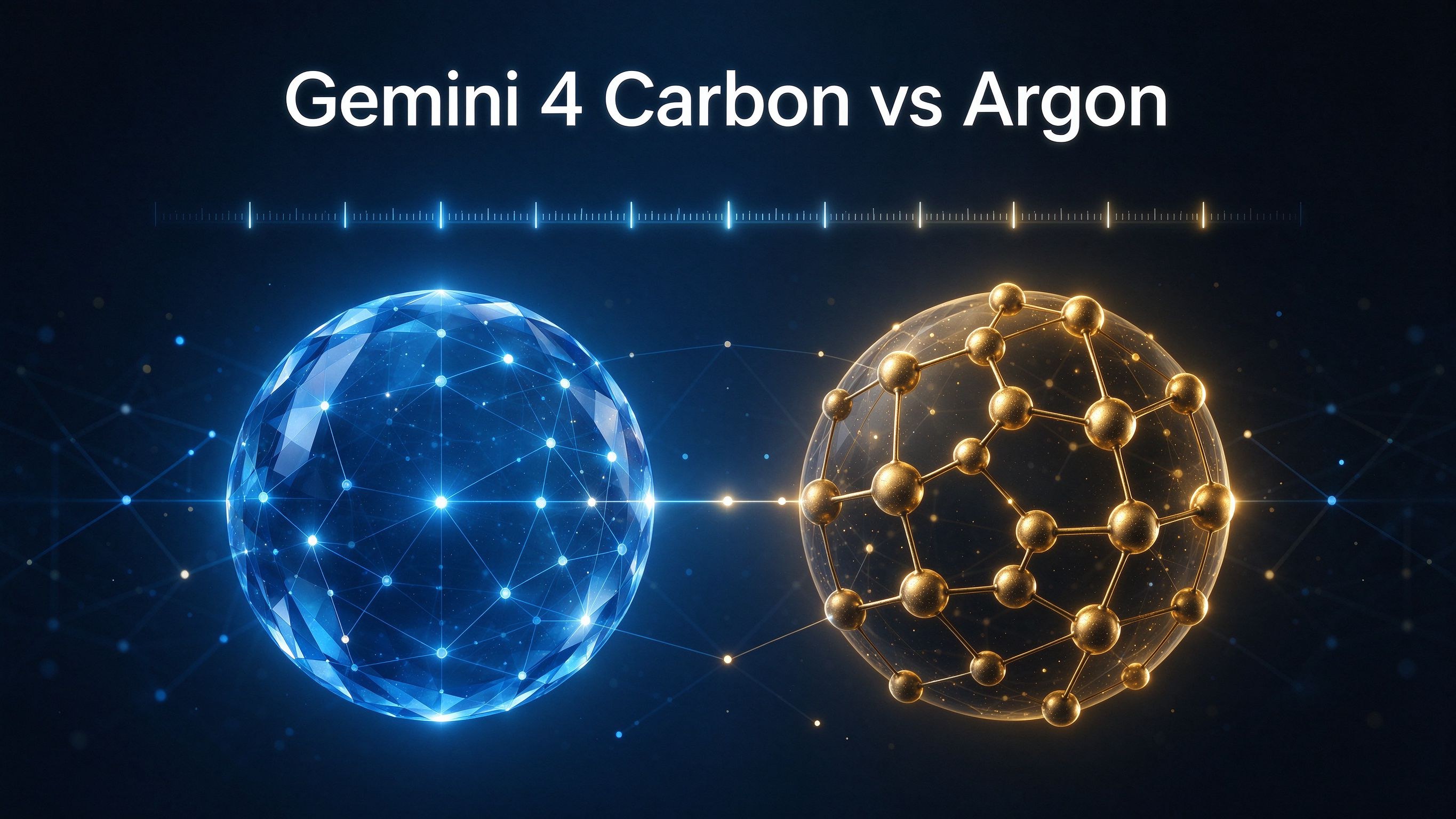
One AI headline from October 2026 is worth keeping: Google announced Gemini 4 Carbon on October 28 and called it its strongest model yet. It scored 59 on the updated Artificial Analysis Intelligence Index, the highest any model has reached, with the biggest gains in coding, long-running agent work and cybersecurity. Access is the catch. Carbon sits with a small group of vetted cyber defenders, while Argon, the model it replaces, is open to everyone. The useful question is therefore not which one is better but which one you can actually get today.
Two flagships, one month apart
Gemini 4 Argon launched October 1 as Google's frontier model and opened to developers, enterprises and consumers in mid-October. Carbon was announced October 28 as the stronger follow-up: #1 on the Artificial Analysis index at 59, and a firm lead on SEC-bench Pro (88+), a benchmark Google highlights for cybersecurity capability.
| Gemini 4 Argon | Gemini 4 Carbon | |
|---|---|---|
| Announced | Oct 1, 2026 | Oct 28, 2026 |
| Positioning | Frontier model for long-horizon reasoning | Strongest model: coding, agents, cyber defense |
| Access | Open to developers, enterprises, consumers | Cyber defenders first (Fairwind program); public date not set |
| API price (intro) | Not published | $2 / $10 per 1M tokens (input/output) |
What Carbon is actually built for
Carbon is aimed at the hard stuff: sustained agent tasks that run for hours, deep coding work, and security work like finding and fixing vulnerabilities. Google is rolling it out carefully. First to trusted cyber defenders through the Fairwind program, because a frontier model this capable needs safety testing at scale before public release.
What this means for normal users
Right now, nothing changes for most people: your everyday Gemini (the free assistant and the API) still runs on models you already use, and Argon remains the capable, widely-available choice. Carbon's public release has no date yet. What you should do: keep an eye on the API changelog. When Carbon opens up, the news will move fast, and pricing ($2/$10 intro, later $4/$20) tells you it's positioned above Argon, not replacing it.
Which one should you use?
If you're doing everyday work (writing, research, light coding, image generation), Argon (and the free Gemini tier) is more than enough and it's available now. If you run heavy agent pipelines or security work, Carbon is the one to watch and test the moment it opens. Either way, you're not missing anything today: Carbon's edge is for long, hard, autonomous jobs, not daily chat.
A three-task test you can run on Argon today
A benchmark score is someone else's test set. Build a small one from your own work, so that the day Carbon opens you can compare instead of guessing.
- A long document: paste 30 pages and ask for a one-page brief with five decisions. Check what it dropped.
- A coding fix: give a failing function and the error, and see whether the patch runs without a second round.
- An honesty check: ask about something that changed last week, and note whether it says it does not know or invents an answer.
For each task, record three things: time to a usable answer, cost of the call, and whether you had to redo it. Keep the file. When Carbon becomes available, run the same three prompts and compare the three numbers, not the leaderboard.
What would actually make you switch
- A long agent task that used to fail halfway now finishes.
- A coding job that needed two rounds now needs one.
- The refusal rate on legitimate requests drops, which matters more than raw quality for production pipelines.
- Cost per finished task falls, even if the per-token price rises, because fewer retries are needed.
Any one of those is a real reason to move. A higher index score on its own is not, because you are paying for finished work, not for a ranking.
What to do while Carbon stays closed
Carbon answers the question of which model is strongest right now, and it is an early, restricted build aimed at agents and cyber defence rather than at ordinary users. Until Google opens it, Argon stays the sensible default. Watch the Gemini API changelog for that opening instead of reading benchmark threads about a model you cannot run.
What a 59 score does and does not tell you
An index score measures how a model performs on a fixed set of tests. It does not tell you latency, price per answer, how often the model refuses a reasonable request, or whether it holds up on your own documents. Treat the number as a reason to try the model, not as a purchase order.
Cost math for the API
The intro price ($2 per million input tokens, $10 per million output tokens) is easy to misread. Work through one batch and the shape becomes clear: 100 long conversations, each with 8,000 input tokens and 2,000 output tokens.
| Item | Volume | Rate | Cost |
|---|---|---|---|
| Input tokens | 800,000 | $2 / 1M | $1.60 |
| Output tokens | 200,000 | $10 / 1M | $2.00 |
| Total for 100 conversations | 1,000,000 | mixed | $3.60 |
That is a few cents per conversation, which is cheap for agent work and expensive for a toy. If the same batch runs at the later $4 / $20 pricing, the total doubles to $7.20. Do the arithmetic before you build a pipeline on intro pricing.
What you can actually use today
| Surface | Model behind it | Access |
|---|---|---|
| Gemini app, free | Current consumer model | Anyone, now |
| Gemini API | Argon | Anyone with a key, now |
| Carbon via Fairwind | Gemini 4 Carbon | Trusted cyber defenders, invitation only |
If you are waiting for Carbon
- Write prompts that name no model. When Carbon opens, the same prompt should work without a rewrite.
- Log cost and latency per task now, so you can compare the day you switch instead of guessing.
- Keep one hard test case from your own work. A benchmark score is not proof until your task passes.
Official Websites (Avoid Phishing)
Fake and phishing sites often rank high in search results. Only use the official URLs below.
AI Chatbots & Assistants
- Geminigemini.google.com