

Say you write marketing copy for small clients. A landing page goes through twenty drafts, and every draft needs the pricing block reworded without touching a single number. You want to run that through an API and bill the client, but you have no idea whether one pass costs a cent or a dollar, so the quote is a guess.
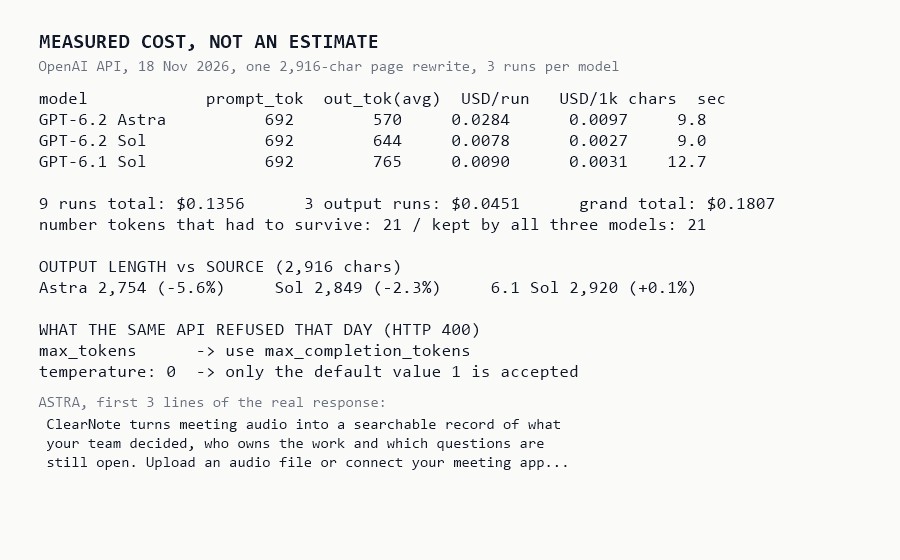
This post replaces the guess with a measured bill. I ran the same 2,916-character page through three OpenAI models, three times each, read the token counts the API returned, and wrote down what each run cost. Total spend for the cost test was $0.1356 across nine calls, plus $0.0451 for three output captures that I read line by line.
The bill, in one table
| Model | Prompt tokens | Output tokens (avg of 3) | Cost per run | Cost per 1,000 characters | Wall time |
|---|---|---|---|---|---|
| GPT-6.2 Astra | 692 | 570 | $0.0284 | $0.0097 | 9.8 s |
| GPT-6.2 Sol | 692 | 644 | $0.0078 | $0.0027 | 9.0 s |
| GPT-6.1 Sol | 692 | 765 | $0.0090 | $0.0031 | 12.7 s |
Read the last two rows together before you pick the cheap one. Sol costs about a quarter of Astra per run, but it also sat in the middle on speed and produced a slightly longer answer. On this one task the choice is not obvious from the price column alone.
How the test was set up
- One input file, 2,916 characters, a fake but realistic product page with nine prices, three dates and a row of percentages.
- One system message and one task instruction, identical for every model. The instruction says to keep every number, price and date exactly as written.
- Three calls per model, so a single slow or weird run could not set the average.
- Token counts copied from the usage field of the API response, not estimated from word counts. That is the difference between this post and a price-page calculation.
- Chat Completions endpoint, no streaming, max completion set to 1,200 tokens, default temperature.
The prompt that keeps every number
The instruction is the part that matters, and it is short enough to paste into any tool. The copy between the tags is what gets rewritten; the constraints around it are what stop the model from rounding your prices.
A rewrite prompt you can paste into any chat tool
Replace the text inside the copy tags with your own page. Works in the OpenAI API, in any chat window and in most hosted tools. If you only need one paragraph, drop the instruction about the first two sentences.
System:
You are a careful product copywriter. Follow the instruction exactly.

User:
Rewrite the page copy between <copy> tags so a first-time visitor
understands what the product does in the first two sentences.
Keep every number, price and date exactly as written.
Return only the rewritten copy, plain text, no headings.

<copy>
[PASTE YOUR PAGE COPY HERE]
</copy>What actually came back
All three models kept every number, which is the result I expected least. Twenty-one required tokens, including USD 12, USD 48, 15 percent, 14 days, 6.1 percent against 2.0 percent, 1,400 workspaces and 90-minute, survived in all three outputs. No model invented a price and none rounded a percentage.
The differences sat in structure, not facts. Astra reordered the first two paragraphs so the payoff comes before the audience description, and compressed the text by 5.6 percent. Sol wrote tighter sentences but kept the original order. GPT-6.1 Sol produced the longest output at 2,920 characters, almost identical to the source, which is safe but barely a rewrite. One formatting tell: Astra returned curly quotation marks around the sample decision line, while the other two used straight quotes.
One sample cannot rank three models on quality, and I am not going to pretend it does. What this sample does show is that at this length, on this kind of task, the cheap model is not obviously worse.
The audit that catches a dropped price
Numbers are the one thing you cannot eyeball across a 3,000-character answer. Keep a list of the tokens that must survive and check them mechanically. This script is what produced the 21 out of 21 result above.
A 15-line number audit for any rewrite
Save the model output as rewrite.txt, put the numbers you refuse to lose in the list, run it. Add every price, date and percentage from your own page. It takes a second and catches the failure that actually costs you a client.
import re

must = [
    "USD 12", "USD 24", "USD 48",
    "15 percent", "14 days",
    "6.1 percent", "2.0 percent",
    "2024", "1,400", "47",
    "90-minute", "30 days", "90 days",
]

out = open("rewrite.txt", encoding="utf-8").read()
missing = [t for t in must if t.lower() not in out.lower()]
print("missing:", missing or "none")
print("numbers found:", len(must) - len(missing), "of", len(must))Three things that will bite you
The API rejected two parameters I had used for years, on the same day, with real error text. max_tokens now returns an unsupported-parameter error and the reply tells you to send max_completion_tokens instead. temperature: 0 is also refused on these models: only the default value 1 is accepted. Both are HTTP 400 responses that cost nothing, but they will stop a script that used to work.
Second, token counts move between runs. Output length varied by about 5 percent across three calls, which is normal, so a budget built on one run is optimistic. Double the estimate before you quote a client.
Third, cost scales with input length, roughly linearly. Feeding a 291,600-character document instead of a 2,916-character one multiplies the input side by about 100, so a $0.028 rewrite turns into roughly $2.80. If you plan to run long documents, price by characters and not by document.
Put the numbers to work
A freelancer doing 20 rewrites a day spends about $0.16 a day on Sol or $0.57 on Astra. At 3,000 rewrites a month, billed at any normal copy rate, that is $23 on Sol against $85 on Astra: real money, but small enough that quality, not price, should decide.
The practical order is: write the constraint into the prompt, run the audit, then choose the model by whether the output needs structural help. On this page Astra did the reorganising work; Sol would need a second instruction to do the same. If you have time to write that second instruction, Sol is fine. If you do not, the price difference buys you the edit.
Every number in this post comes from run logs stored in the project, not from a price page. The two scripts that produced them are the ones printed above, and the whole experiment cost $0.18. Rerunning it on your own copy is the only way to know your real per-article number.